

I want to share with all of you an update on this topic, after several tests during these last weeks.
First, I want to highlight the excellent support from Terra-Master. They shipped me a brand-new Terra-Master F4-425 Pro (N350) NAS unit straight from their factories in China, and I'd like to thank their team for handling this so promptly.
Now let's talk about the problem with the F4-425 Pro model, which uses the Intel N350 chip:
Throughout, Terra-Master support indicates that the initial batch of this model had an issue with thermal paste that was not applied properly at the factory. I'm not going to contradict Terra-Master support, but I think there's more to it. I'm not denying that these early batches had the thermal paste issue, but I feel like there's something else going on with this specific model. There's definitely a bigger problem here at least.
On the first unit I received from Amazon, since I bought this unit directly from Amazon, the PL1 value in the BIOS was set to 13,500 or 13.5 watts. This is the second unit sent by Terra-Master support from China. I've checked the BIOS on this unit, and out of the box, the PL1 value on this received unit is 12,000 milliwatts, or 12 watts. In other words, we can see that aside from the thermal paste issue, there is something else going on here. This value, which was 13.5 watts on the first unit, is now 12 watts, and that already points to something else.
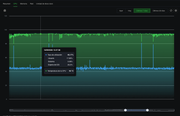
After putting this unit through prolonged "torture testing", how does it hold up? Frankly, its thermal performance is neither correct nor efficient. The unit immediately and rapidly hits 94°C and goes into thermal throttling, meaning it constantly drops its frequency because it keeps hitting that 94-degree mark. Meanwhile, the unit's fan is running constantly at its maximum possible RPM.
This is clearly not the right situation. Hitting 94 degrees and entering thermal throttling is definitely not right, nor is it desirable for a NAS unit subjected to prolonged workloads, which is something these types of units have to handle on many occasions.
After several different tests, I've adjusted the PL1 value to 10 W, or 10,000 mW. Under this setting, the unit's temperature during stress testing hovers around 80 °C, which is a solid and, in my view, ideal result.
I've attached two images. The first one shows the temperature graph with the factory-default PL1 value on the second unit sent by TerraMaster support, which is set to 12 watts:
The second image shows the current state of this unit, with the PL1 value already changed by me to 10 watts:
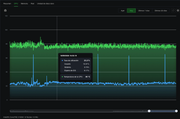
I should note that with the PL1 value changed to 10W, the unit's fan does not reach maximum RPM, topping out at around 1,300 RPM instead of the maximum 1,400 RPM under load.
Now, my opinion on this whole situation and these F4-425 Pro units with the Intel N350 chip: I wanted to share this with all of you, as this is my reflection, and I think TerraMaster should also listen to these thoughts.
I think the issue with this unit is industrial design. Specifically, the layout features four 3.5-inch drive bays, with the motherboard, memory, M.2 drives, and CPU heatsink positioned off to the side. That industrial design with a single fan just doesn't provide adequate cooling for that side-mounted board where all the system components are housed. For less powerful processors, perhaps quad-core or with an architecture that doesn't require much ventilation, this kind of design can work. But here, obviously, there's a problem: the industrial design doesn't guarantee adequate cooling because the processor heatsink is constrained in a space where it can't increase in size, and that's probably the situation.
Maybe another industrial design where that part of the motherboard, along with all its components, took up half the case, with two storage drives on one side and two on the other, meaning 3.5-inch drives. In other words, perhaps in a design where a single fan could adequately ventilate all the components.
I hope that was helpful.

