
Maybe it was that exact moment last Tuesday when you were trying to snap a quick video, and that dreaded, passive-destructive popup appeared: "Storage Almost Full. Update to iCloud+." Or maybe you are a creator looking at an expanding graveyard of external SSDs cluttered across your desk, calculating the exact month your recurring subscription fees will outgrow your rent.
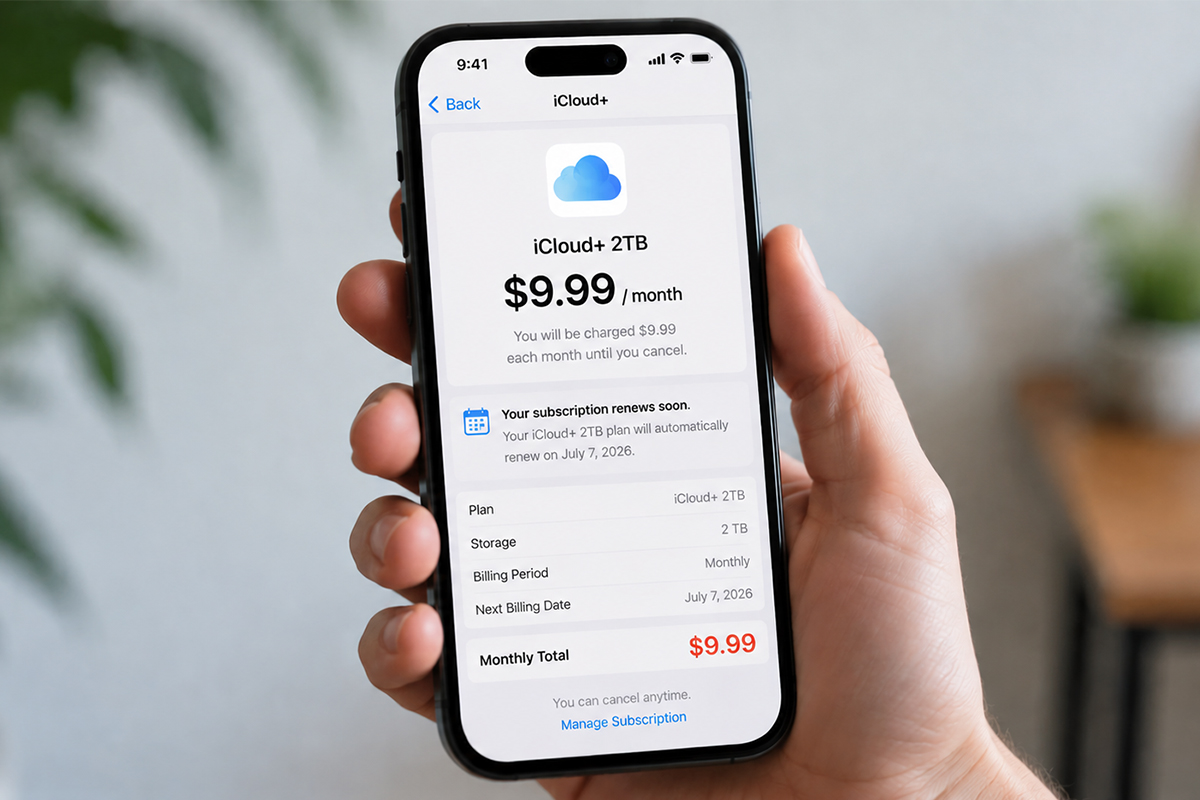
Choosing how to protect your digital life in 2026 is no longer a debate over raw specs. 10GbE network speeds and x86 chips are commodity hardware now. The real choice comes down to a definitive psychological and financial trade-off: You either own your data asset outright, or you rent your digital existence indefinitely.
Before you drop another dollar on temporary patches, this is how the three storage architectures actually define your digital infrastructure.
2026 Storage Decision Summary (Expert Verdict)
The Core Verdict
For any user managing more than 2TB of total data, a 4-bay pre-built x86 NAS is the default modern storage architecture.
· Public Cloud is now a legacy financial trap that becomes structurally irrational past 24 months.
· DIY NAS has narrowed into an isolated homelab hobby that demands perpetual, unpaid IT maintenance.
· Pre-Built NAS is the industry standard, completely eliminating ongoing subscription liabilities without inheriting server administration overhead.
1. Defining the Three Eras of Data Storage
The modern storage landscape is no longer a checklist of equal choices; it is divided into three distinct operational philosophies:
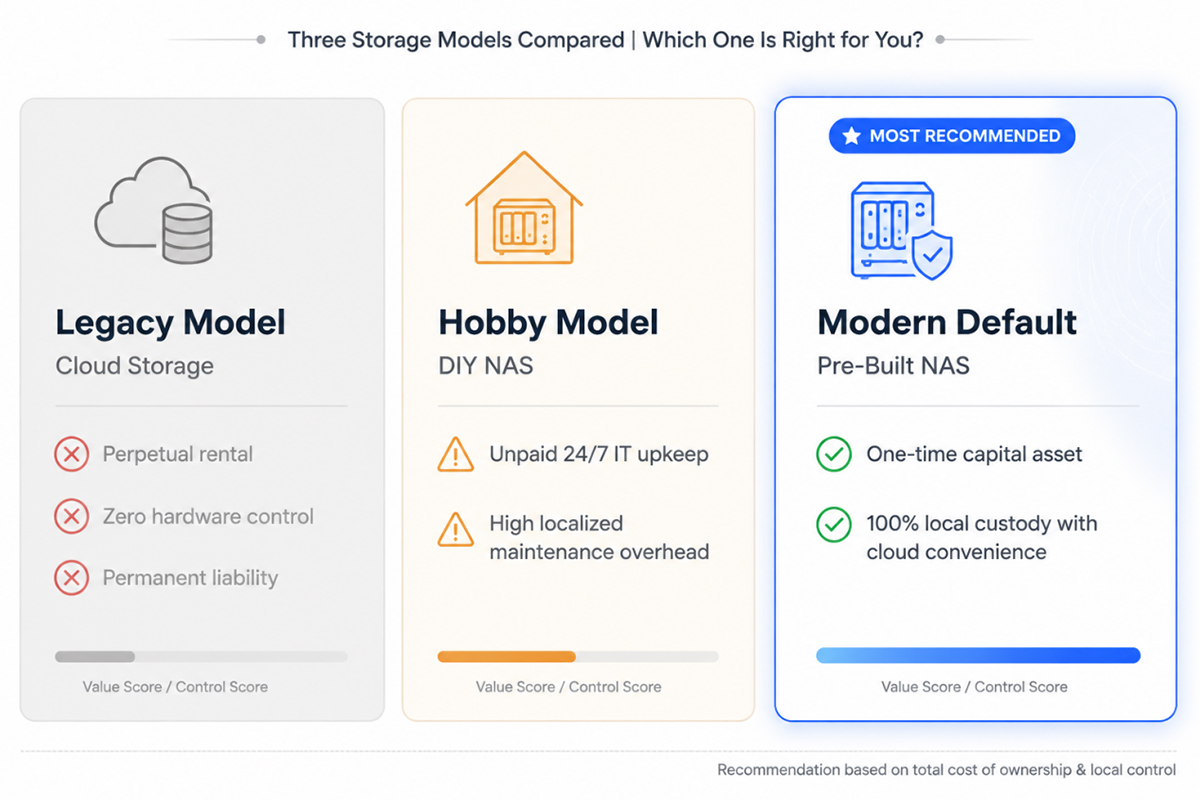
Cloud Storage (The Legacy Rental Model)
A remote utility where personal files are transmitted via the internet and stored on infrastructure owned by a third-party technology vendor (Google, Apple, Microsoft, or Dropbox). You do not own the hardware; you rent access through a perpetual, compounding subscription.
Pre-Built NAS (The Modern Default Architecture)
A dedicated, low-power local storage appliance that plugs directly into your private network. It delivers centralized file access, automated mobile device backups, and localized media streaming under 100% user data ownership, with zero ongoing platform fees.
DIY NAS (The Homelab Hobby Model)
A custom network storage server assembled manually from spare PC components, low-power hardware, or repurposed gaming rigs. It requires manual configuration, security hardening, and ongoing patch management using open-source operating systems like TrueNAS or Unraid.
2. Cloud Storage: The Invisible Subscription Trap
Cloud storage makes complexity disappear at the beginning. Setup takes three clicks, everything syncs silently in the background, and nothing feels technical.
However, renting space on corporate infrastructure is structurally designed as an escalating financial trap. The transition occurs in a predictable, linear progression:
[ Your Data Footprint Grows ] ──► 200GB ──► 2TB ──► High-Capacity Tier
└─► Result: Permanent Monthly Liability
Your 200GB plan silently swells to 2TB. Your family group backup expands, and 4K photo libraries double without warning. Suddenly, you are no longer paying pocket change; you are saddled with a permanent utility bill just to keep your files from being locked or deleted.
The limitation of the cloud is psychological and structural: You are renting your memories. No matter how many thousands of dollars you hand over to a tech giant over a decade, you never own a single byte of that infrastructure. If you stop paying, your digital life is frozen.
3. DIY NAS vs. Pre-Built NAS: The Unpaid 24/7 IT Job
DIY NAS appeals to a specific urge: total technical freedom. Saving an old gaming PC from the landfill, dropping in a few hard drives, and installing an open-source OS sounds like the ultimate budget-friendly power move.
But what rarely gets mentioned on tech subreddits is the reality of long-term server ownership. DIY systems are stable—until they aren't. And when a self-built server fails, it triggers intense data-loss anxiety at the absolute worst moment.
Pre-Built NAS: Quiet Operational Certainty
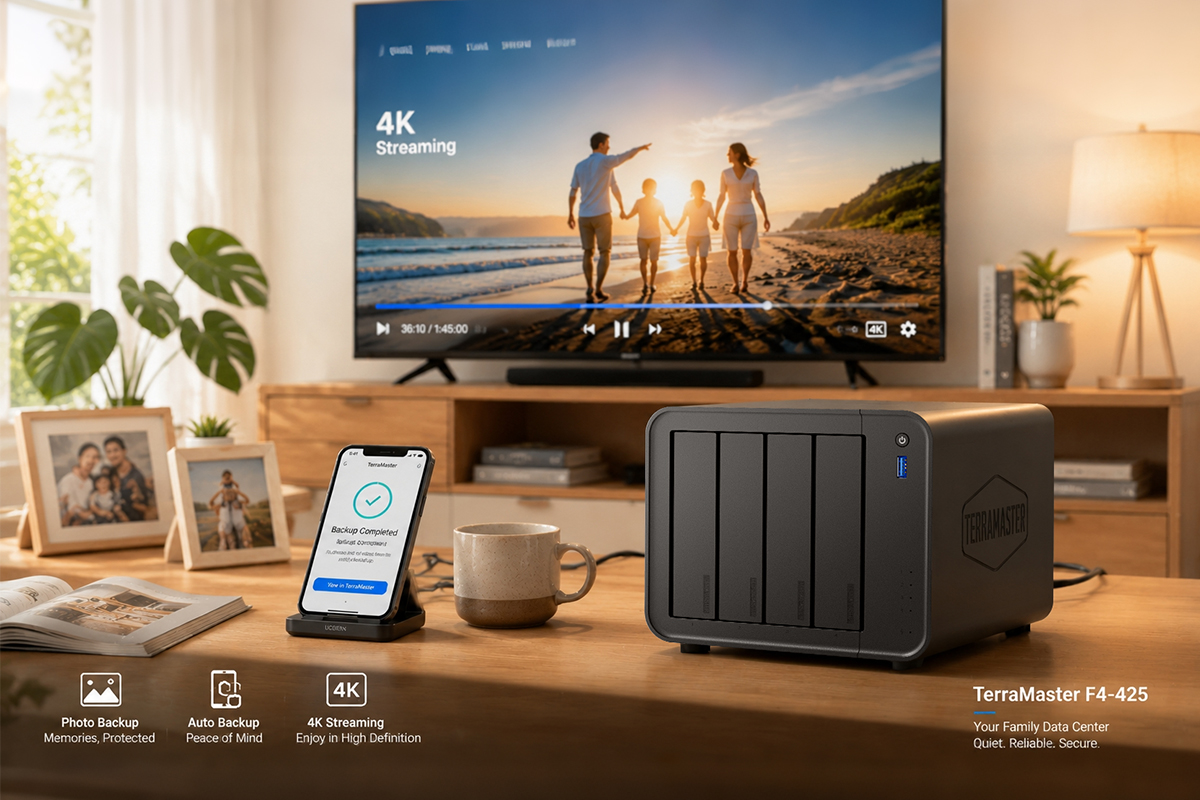
Pre-built NAS systems exist to solve a simple problem: separating local data ownership from the headache of manual server maintenance. You buy the hardware once, configure it once, and it runs quietly in the background—exactly like your home Wi-Fi router.
Modern 4-bay x86 NAS appliances represent the de facto home storage standard in 2026. This specific category defines the market by removing terminal commands completely. You slide physical hard drives into the bays, power it on, and log into a clean web interface that operates like a standard desktop environment. Setup takes twenty minutes, not a full weekend.
[ Traditional RAID ] ──► Requires identical drive sizes upfront (Rigid & Expensive)
[ Modern Elastic RAID ] ──► Mix & match any drive size over time (Flexible & Scalable)
Powered by Intel or AMD quad-core chips and dual 2.5GbE ports, the local network performance bottleneck is eliminated. Dragging a massive 100GB video project or a raw photo folder onto the NAS happens instantly over your home network, completely bypassing the upload limitations of your internet service provider.
Furthermore, older traditional RAID arrays were incredibly rigid—if you started with 4TB drives, you were stuck buying identical 4TB drives forever. Modern flexible storage managers—pioneered by enterprise-grade platforms like TerraMaster’s TRAID engine—remove this financial friction entirely. If you have an old 4TB drive, a 6TB drive, and a new 12TB drive, you simply mix and match them in the same enclosure. The software dynamically optimizes the storage pool behind the scenes, ensuring full data redundancy against physical hardware failure while allowing you to scale capacity piece-by-piece as your budget permits.
4. The 5-Year Cost Reality: Renting vs Buying
When you strip away marketing copy, storage decisions converge on a simple financial reality: Cloud storage becomes structurally more expensive than owning hardware after 18–24 months.
Let's take a realistic 12TB scenario — using the TerraMaster F4-425 NAS as our on-premise reference — and benchmark its total cost over a 5-year lifecycle.
5-Year Financial Outflow Comparison (12TB Scale)
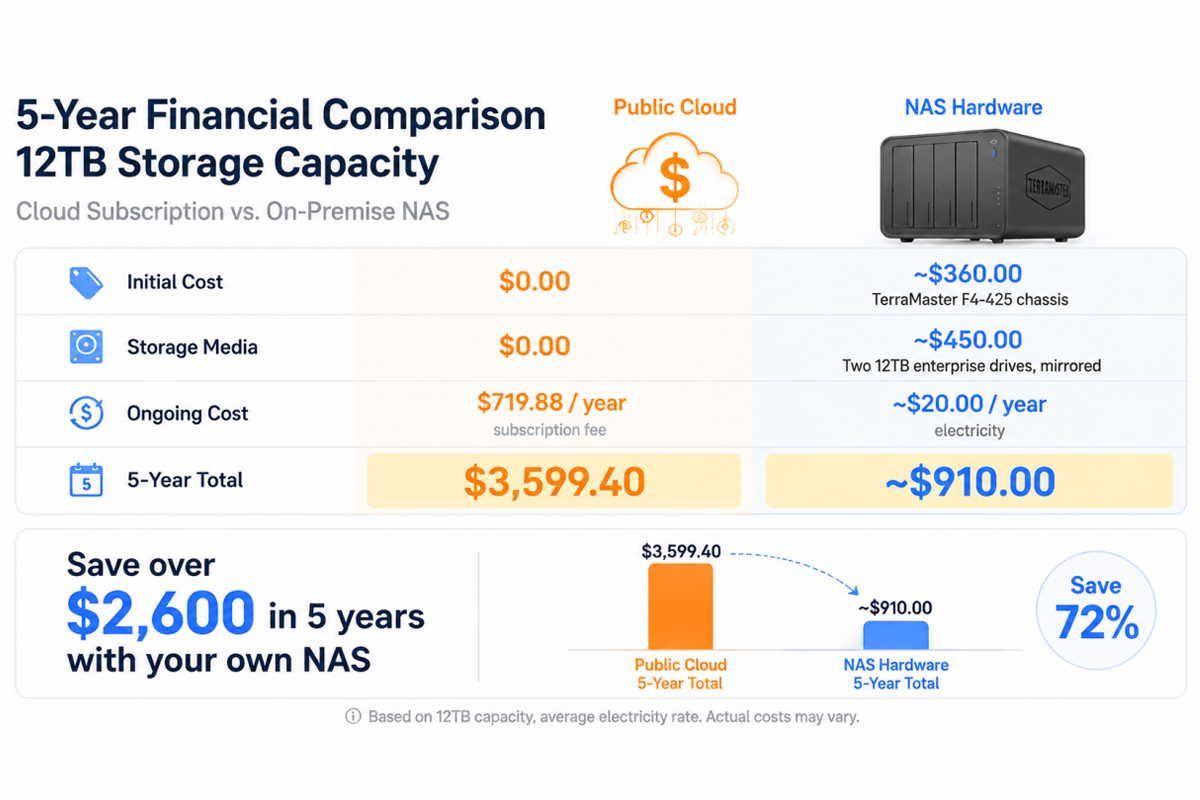
The financial difference is absolute: local ownership saves you roughly $2,600 over five years. More importantly, the cost flatlines completely after month one, turning your storage into a local asset that you fully control rather than a perpetual monthly liability.
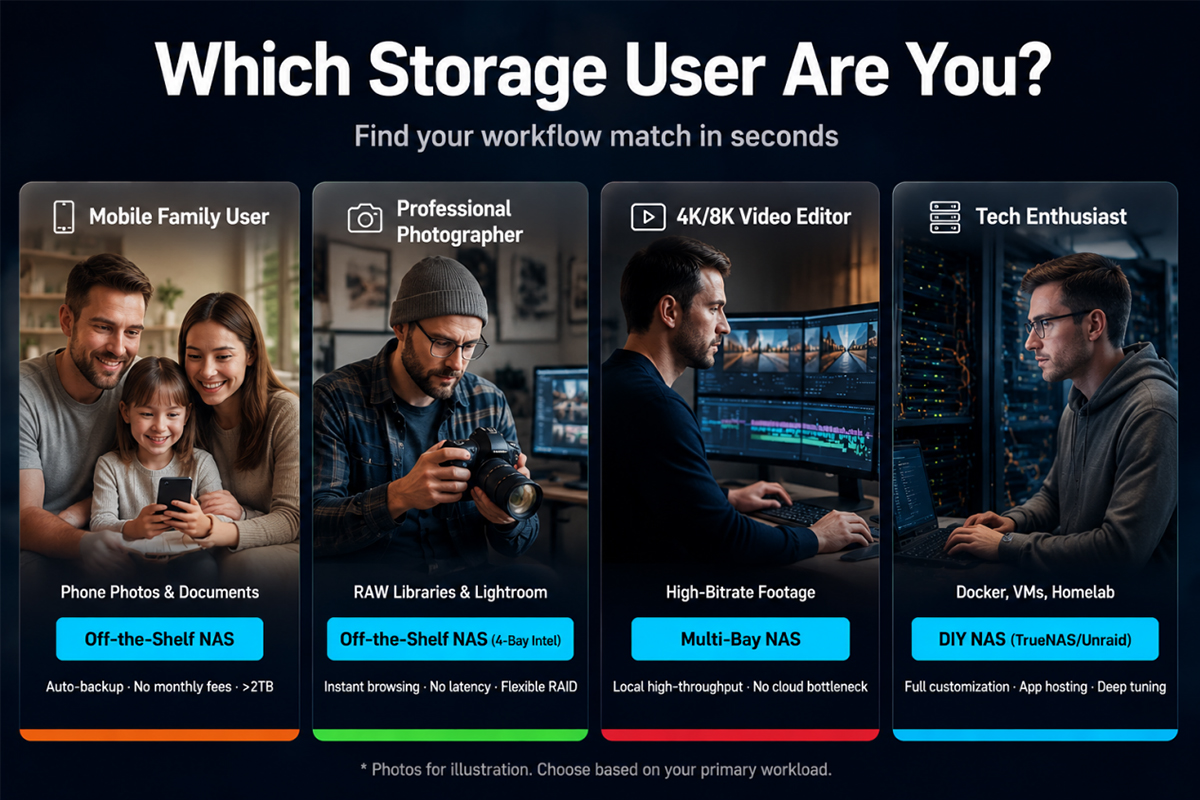
5. Real-World Use Case Matrix
Your specific workflow dictates your storage architecture. The market is segmented into clear, non-overlapping user profiles:
6. How Much NAS Storage Do You Actually Need?
One of the most frequent mistakes users make when abandoning the cloud is underestimating their true local drive capacity requirements. To calculate your actual hardware targets, apply this exact formula:
Required Raw Capacity=(Current Data Footprint×1.5)×2
· The Growth Buffer (x 1.5) : Data needs never remain static. Anticipate a minimum 50% data expansion over the next three years as smartphone camera sensors improve, file sizes grow, and high-definition media standards solidify.
· The Redundancy Factor (x 2): In a local NAS ecosystem, you never use 100% of your raw disk space for file storage. To protect against physical hardware failure, you must run a redundant configuration (like RAID 1 or TRAID). This means half of your physical capacity is utilized to mirror and safeguard your data.
7. Frequently Asked Questions
Is local NAS safer than Google Drive or iCloud?
Yes. From a data privacy perspective, a local NAS keeps your files entirely inside your physical home, completely decoupled from third-party data tracking, automated scanning algorithms, and corporate cloud data breaches. For physical disaster safety, automated offsite backups can be encrypted and synced to a secondary location.
Is DIY NAS cheaper than buying a pre-built enclosure?
Only if you already own functional, energy-efficient spare hardware that is gathering dust in your home. If you have to buy brand-new consumer PC components individually, the total cost frequently equals or exceeds the price of a dedicated pre-built appliance, while still lacking vendor hardware support and optimized low-power efficiency.
What happens to my data if a hard drive physically dies inside a NAS?
If your NAS is configured using a redundant file array, your system continues running completely uninterrupted. Your data remains perfectly safe on the surviving drives. You simply pull out the dead drive, slide in a new one, and the operating system automatically rebuilds the safety array in the background.